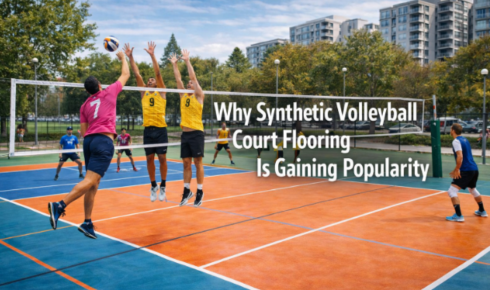
Volleyball is a fast-paced sport that relies heavily on jumping ability, quick lateral movement, and controlled landings. As the sport continues to grow across schools, sports academies, and indoor facilities, increasing attention is being given to the quality of the playing surface. In recent years, synthetic volleyball court flooring has emerged as a preferred choice for many modern facilities.
This article explores why synthetic volleyball court flooring is gaining popularity, focusing on performance, safety, durability, and its role in contemporary volleyball court construction.
The Evolving Needs of Modern Volleyball Courts
Traditional volleyball courts were often built with basic flooring solutions that focused primarily on availability rather than performance. However, modern volleyball demands surfaces that support athletic movement while reducing injury risks.
Today’s volleyball courts must accommodate:
- Frequent jumping and landing
- Quick changes in direction
- Extended training and match sessions
- High player foot traffic
These demands have driven facilities to adopt advanced volleyball court flooring solutions that deliver consistency and reliability.
Importance of Volleyball Court Flooring in Gameplay
The playing surface directly influences how players move, jump, and land. Poor flooring can affect grip, balance, and overall confidence during play. High-quality volleyball court flooring ensures predictable movement and allows players to perform without hesitation.
Synthetic flooring systems are designed to provide uniform surface behavior across the court, helping maintain fair and consistent playing conditions.
Standard Volleyball Court Dimensions and Surface Planning
A professional volleyball court follows standardized dimensions to ensure proper gameplay. A regulation volleyball court measures 18 meters in length and 9 meters in width. Maintaining accurate volleyball court dimensions is essential for player positioning, movement patterns, and match fairness.
Surface planning during volleyball court construction ensures that the flooring system aligns correctly with these dimensions. Even surface leveling and accurate line marking are crucial for consistent performance.
Understanding Volleyball Court Material Options
The choice of volleyball court material plays a major role in performance and durability. Traditional materials such as wooden floors or basic cement surfaces have been widely used, but they often require higher maintenance and may not offer consistent shock absorption.
Synthetic volleyball court flooring materials are engineered to address these challenges by providing:
- Controlled traction
- Consistent surface texture
- Resistance to wear
- Compatibility with modern indoor environments
These advantages make synthetic materials suitable for both training and competitive volleyball courts.
Why Synthetic Volleyball Court Flooring Stands Out
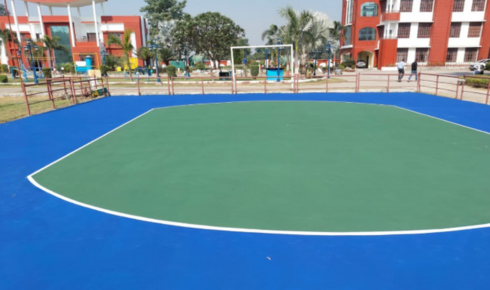
Synthetic volleyball court flooring systems are designed to meet the physical demands of the sport. These surfaces are typically seamless and layered, creating a uniform playing area that supports player movement.
Key reasons for their growing popularity include:
- Reliable grip for jumping and landing
- Balanced surface hardness
- Consistent performance across the court
- Reduced surface-related fatigue
By offering predictable surface behavior, synthetic flooring allows players to focus on skill and strategy rather than surface adjustment.
Player Safety and Shock Absorption
One of the primary reasons synthetic volleyball court flooring is gaining popularity is its contribution to player safety. Volleyball involves repeated jumps, blocks, and dives that place stress on knees, ankles, and lower back.
Synthetic flooring systems are designed to absorb and distribute impact forces more evenly than rigid surfaces. This helps reduce joint strain and lowers the risk of impact-related injuries, especially during long training sessions or tournaments.
Grip and Stability During Play
Grip is critical in volleyball, particularly during quick lateral movements and sudden stops. A surface with inadequate traction can increase the risk of slipping, while excessive grip may restrict natural movement.
Synthetic volleyball court flooring is engineered to provide controlled traction. This balance supports stability without limiting mobility, allowing players to move confidently during rallies and defensive plays.
Durability in High-Usage Facilities
Volleyball courts in schools, colleges, and sports complexes often experience continuous use. Durability is therefore a key consideration in volleyball court construction.
Synthetic volleyball court flooring is designed to withstand:
- Heavy foot traffic
- Repeated jumping and sliding
- Routine cleaning and maintenance
These surfaces maintain their performance characteristics over time, making them suitable for facilities with high usage demands.
Maintenance and Long-Term Efficiency
Maintenance requirements influence the long-term cost and usability of a volleyball court. Traditional surfaces may require frequent refinishing or repairs, which can disrupt facility schedules.
Synthetic volleyball court flooring systems are relatively easy to maintain. Seamless surfaces help prevent dust accumulation and uneven wear, while routine cleaning is usually sufficient to preserve surface quality. This makes synthetic flooring a practical option for long-term facility management.
Role of Flooring in Multi-Purpose Facilities
Many modern sports facilities are designed to host multiple indoor activities. Synthetic volleyball court flooring is often chosen for its adaptability in such environments.
When properly planned during volleyball court construction, synthetic surfaces can support volleyball while remaining compatible with other indoor sports. This flexibility adds value to sports halls and institutional facilities.
Installation and Construction Considerations
The performance of any volleyball court flooring system depends on correct installation. Surface preparation, leveling, and curing processes all influence how the flooring performs over time.
Professional volleyball court construction follows structured installation practices to ensure uniform thickness, stability, and surface consistency. Synthetic flooring systems respond well to precise installation, delivering reliable long-term results.
Conclusion
Synthetic volleyball court flooring is gaining popularity due to its ability to meet the performance, safety, and durability demands of modern volleyball. From supporting accurate volleyball court dimensions to enhancing player comfort and reducing maintenance needs, synthetic surfaces offer a balanced solution for today’s sports facilities.
As volleyball continues to grow across educational institutions, academies, and recreational centers, the role of high-quality volleyball court material becomes increasingly important. Thoughtful volleyball court construction that includes advanced synthetic flooring helps create safer, more efficient courts that support both athletes and the game itself.